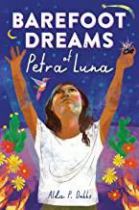
Based on a true story, the tale of one girl’s perilous journey to cross the U.S. border and lead her family to safety during the Mexican Revolution.

Based on a true story, the tale of one girl’s perilous journey to cross the U.S. border and lead her family to safety during the Mexican Revolution.
Abia is the self proclaimed Queen of the Shimelba refugee camp, facing her displacement with strength, imagination, and pride.
Dounia is the story of a little girl who loves her home city of Aleppo, Syria, and its many smells, sights, and traditions. But when war breaks out, Dounia and her grandparents must flee Aleppo to find safety. Before they go, their neighbour reads their future in a cup of coffee, she sees a long difficult journey ahead of the family and a blue house awaiting them at the end. Taking only a bird carved from Aleppo soap and four little barake seeds in her pocket, Dounia faces dangerous waters, a camp surrounded by barbed wire, and unfriendly soldiers, and she wonders where she and her family belong in the world. Remembering the ancient knowledge that barake seeds ward off evil, she pulls one from her pocket to use for each of the threats they face. Magically, the seeds from their faraway home help them along their way, until they finally find the blue house at the end of their journey.
In her new home, Dounia plants her final seed in a pot so it can grow and offer more seeds, while also keeping a piece of Aleppo with her. The baraké seeds represent the Syrian culture. Although Dounia is fleeing her country, she carries with her the strength of her people. It is by tapping into her roots, represented by the seeds, that she finds her own strength and resilience. The magical moments brought about by the baraké seeds can be interpreted as Dounia’s imagination it’s a way of seeing the war and the migration from a six year old’s perspective. Dounia does not understand everything that is going on, but she is not a powerless victim. By using the seeds, she feels she is taking an active part in her own destiny. In the end, whether it is magic or Dounia’s imagination at play, it’s a story about obstacles faced by migrants and about the courage they have in facing these obstacles. As Marya puts it in her article for TBI Magazine, it reverses the common narrative in North American media that Syria is synonymous with devastation and destruction, and that Syrian refugees can only be victims of their circumstance, rather than brave, vibrant heroes who can take charge of their own stories.
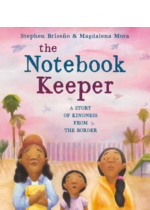
After traveling to Tijuana, Mexico, Noemi and her mother are denied entry at the border and must find the refugee in charge of the notebook, an unofficial ledger of those waiting to cross into the United States. Includes author’s note.
The Notebook Keeper was featured in the WOW Currents The Power of Home: Promise or Uncertainty? Part II.
Ten ghost stories about Chinese people who, having come to North America to make their fortunes, encounter ghosts who either help or hinder their success.
When nine-year-old Li, her mother, and brother Puck arrive from China at Angel Island immigration center in 1921, Li fears she will be deported for failing the tests. Includes historical notes and glossary.
When hard times fall on his family, Jo Lee is sent from China to San Francisco, where he helps his uncle fish and dreams of being reunited with his mother and sister.
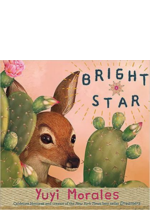
With the combination of powerful, spare language and sumptuous, complex imagery characteristic of her work, Yuyi Morales weaves the tale of a fawn making her way through a landscape that is dangerous, beautiful—and full of potential. A gentle voice urges her onward, to face her fears and challenge the obstacles that seek to hold her back.
Marisol loves her colorful island home. Cuba is vibrant with flowers and food and people but things are changing. The home Marisol loves is no longer safe, and then it’s no longer her home at all. Her parents are sending her to the United States. Alone.
Nothing about Marisol’s new life in cold, gray Brooklyn feels like home, not the language, school, or even her foster parents. But Marisol starts to realize that home isn’t always a place. And finding her way can be as simple as staying true to herself.
Featured in WOW Review Volume XIV, Issue 4.
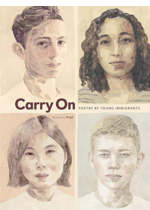
Carry On began in a high school in Outremont, Quebec, where author and poet Simon Boulerice conducted creative-writing workshops for young newcomers to Canada. As the students began writing, their poems gave voice to their reflections on leaving family, friends, and countries of origin to make new homes and connections in their new home, Canada.
Paired with expressive portraits by award-winning artist Rogé, each young writer reflects on the experience of leaving one home for another. The collection of poems express feelings of anxiety, sorrow, anticipation, gratitude, and hope for the future. With thoughtful verse and evocative illustrations, Carry On is a tribute to human resilience, the voices of newcomers, and creating empathy for all those who wonder about their place in the world.