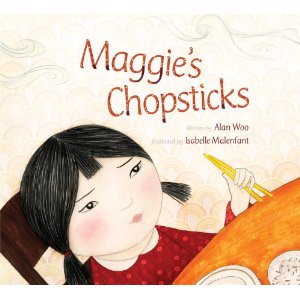
Maggie comes from a family of unique individuals, all with their own opinions and style, each one of them willing to give advice on how the child should hold her new chopsticks. Maggie listens to all of them in turn, weighing her options. Grandmother suggests using chopsticks in a rather forthright way, while Sister suggests a more graceful approach. As Maggie begins to worry that she may never find her own style, her father suggests that she be herself. Because of his encouragement, she is able to find just what works for her. Maggie comes from a traditional Chinese family, and she clearly wants to make them proud. Woo writes in a way that transforms a story about holding utensils into a poetic journey. Not only is Maggie learning the mechanics of chopsticks, but she is also learning to be herself. Language such as “click-clack-clicketing” and, as she circles her chopsticks above her fish tank, “the fish flee/from the wooden fingers/reaching through their sky of blue” makes children want to turn the page and find out what else Maggie will experience. In Malenfant’s vibrant illustrations, deep reds and shimmering oranges leap from the pages. All children are fascinated with holding utensils, whether a fork, a spoon, or chopsticks, and are anxious to please adults while staking out their own individuality, making this a great choice for kids of all ethnic backgrounds.