Greek Myths

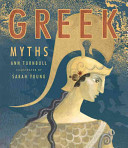
A gorgeous collection of classic Greek myths welcomes readers of all ages into a legendary world of beauty, tragedy, and miracle. Enter a world where anything is possible. A god might be a mountain or a shower of gold. A nymph may be a stream or an echo in the wind. The myths of ancient Greece are full of such wonders, as well as a host of courageous heroes, cunning heroines, and terrible monsters. Ann Turnbull’s compelling prose enlivens sixteen of the most celebrated myths, from the sadness of Persephone to the ill-fated love of Orpheus and Eurydice, from Pandora’s unlucky curiosity to the greed of King Midas to many more age-old tales filled with drama and romance. In vivid, expressive detail, Sarah Young’s fine-art illustrations bring this golden world to life, capturing creatures from Cerberus, the threeheaded dog, to the sinister snake-haired Medusa.

Moon Watchers

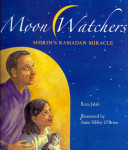
Looking through the tall trees in their backyard in Maine, Shirin and her dad search for a glimpse of the new moon, the sign that the month of Ramadan has begun. Ramadan is a time when Muslims around the world pray, fast, and pay special attention to doing good deeds. Shirin is nine and thinks she should be able to fast like her older brother Ali, but her parents feel she is still too young to go without food and water all day. When Shirin catches Ali sneaking food after school, she wonders: Should she tattle or is this an opportunity for a good deed? Shirin feels left out when the others break their fasts to have their own meals after dark and in the early morning, before it is light again. But then her grandmother tells a story that shows her a way she can feel more a part of Ramadan and the traditions and closeness her family enjoys during this special month of the year. Her good deeds result in a surprise for everyone.

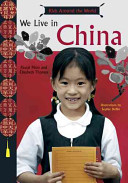
We Live In China

Travel the world in this new series of illustrated books, and see each country through the eyes of the children that live there!Meet Meihua, a girl from Beijing; Shuilin, from a smaller province; and Sem Dui, a boy from Tibet. Learn about China’s school system, traditions, history, religion, and culture—just by spending a day with these children. With illustrations and photographs throughout, featuring some of the most important architecture and historical figures of the region, this book provides a great introduction to Chinese culture. Travel the world in this new series of illustrated books, and see each country through the eyes of the children that live there!Meet Meihua, a girl from Beijing; Shuilin, from a smaller province; and Sem Dui, a boy from Tibet. Learn about China’s school system, traditions, history, religion, and culture—just by spending a day with these children. With illustrations and photographs throughout, featuring some of the most important architecture and historical figures of the region, this book provides a great introduction to Chinese culture.

Then

“Then is the second story of Felix and Zelda. They escaped from the Nazis, but how long can they now survive when there are so many people ready to hand them over for a reward? Thanks to the courage of a kind, brave woman they are able to hide for a time in the open, but Felix knows he has a distinguishing feature that identifies him as a Jew and that it is only a matter of time before he is discovered, which will mean death for them all. Even though he promised Zelda he would never leave her, he knows he has to, before it is too late…”–Provided by publisher.

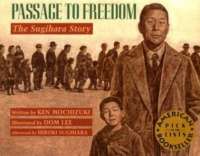
Passage to Freedom: The Sugihara Story

In 1940, Chiune Sugihara-a Japanese diplomat stationed in Lithuania-risked his life to issue thousands of exit visas to Jewish refugees fleeing from the Nazis. Seen through the eyes of his son, Hiroki, who was five years old at the time, this moving story shows how one person can truly make a difference.

Fatty Legs

The moving memoir of an Inuit girl who emerges from a residential school with her spirit intact.Eight-year-old Margaret Pokiak has set her sights on learning to read, even though it means leaving her village in the high Arctic. Faced with unceasing pressure, her father finally agrees to let her make the five-day journey to attend school, but he warns Margaret of the terrors of residential schools.At school Margaret soon encounters the Raven, a black-cloaked nun with a hooked nose and bony fingers that resemble claws. She immediately dislikes the strong-willed young Margaret. Intending to humiliate her, the heartless Raven gives gray stockings to all the girls — all except Margaret, who gets red ones. In an instant Margaret is the laughing stock of the entire school.In the face of such cruelty, Margaret refuses to be intimidated and bravely gets rid of the stockings. Although a sympathetic nun stands up for Margaret, in the end it is this brave young girl who gives the Raven a lesson in the power of human dignity.Complemented by archival photos from Margaret Pokiak-Fenton’s collection and striking artwork from Liz Amini-Holmes, this inspiring first-person account of a plucky girl’s determination to confront her tormentor will linger with young readers.

See the review at WOW Review, Volume 4, Issue 2

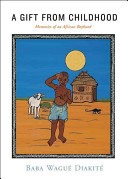
A Gift from Childhood: Memories of an African Boyhood

Baba Wagué is only four years old when he is sent to the tiny Malian village of Kassaro to be raised by his paternal grandparents, according to the family tradition. He is most unhappy about this at first, but under his grandmother’s patient and wise tutelage he comes to love his close-knit village community. He learns how to catch a catfish with his bare hands, flees from an army of bees, and mistakes a hungry albino cobra snake for a pink inner tube. Finally, Grandma Sabou decides that Baba is educated enough to go to school, and he moves back to the city, where his family struggles to provide him with a formal education. But he brings his village stories with him, and in the process of sharing them with his neighborhood uncovers his immense artistic and storytelling talents.

A Hare in the Elephant’s Trunk

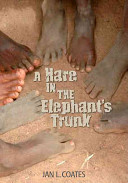
In the little village of Duk Padiet in southern Sudan, a boy named Jacob Deng thrives on the love of his mother, the companionship of his sisters, the excitement of learning how to look after his uncle’s herds of cattle. The year is 1987, and suddenly in the night soldiers from the north invade the village, looting, burning, and killing. The war has arrived, and the life of Jacob will never be the same. This novel is based on the real life experiences of a Sudanese boy who, with thousands of other boys from the region, fled for his life and spent seven years walking through deserts, grasslands and forests, crossing crocodile-infested rivers, surviving life in massive refugee camps. The so-called Lost Boys of Sudan – as they were called by an American aid organization – numbered as many as 27,000, and while many died – from starvation, attacks by wild animals, drowning, or through the brutality of the military – many survived. Jacob never returned to his village, but though he was only seven years old when he had to flee, he somehow managed to live through an almost unimaginable ordeal. Throughout the seven years covered in this story, Jacob resists the temptation to join the liberation army. Steadily Jacob finds himself more and more adhering to his mother’s advice that getting an education is crucial to escaping the cycle of violence that afflicts his country. Jacob’s struggle, then, is to persist in seeking out teachers and eventually a school where his ambition to learn about the world can be met. Through it all he learns about loyalty and love for close friends who have been thrust together with him on this extraordinary journey, and also about the guiding light provided by the memory of his mother.

See the review at WOW Review, Volume 4, Issue 2

My Havana: Memories of a Cuban Boyhood

Relates events in the childhood of architect Secundino Fernandez, who left his beloved Havana, Cuba, with his parents, first to spend a year in Spain, and later to move to New York City.

The Secret Of The Yellow Death: A True Story Of Medical Sleuthing

Red oozes from the patient’s gums.  He has a rushing headache and the whites of his eyes look like lemons. He will likely die within days. Here is the true story of how four Americans and one Cuban tracked down a killer, one of the word’s most vicious plagues: yellow fever.  Set in fever-stricken Cuba, the reader feels the heavy air, smell the stench of disease, hear the whine of mosquitoes biting human volunteers during the surreal experiments. Exploring themes of courage, cooperation, and the ethics of human experimentation, this gripping account is ultimately a story of the triumph of science.