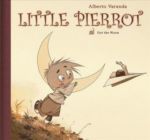
In this wordless picture book, each image starts with a single line, whether made by a pencil or the blade of a skate–and the magic flows from there.
Age
Catalog sorted by age group
Under The Silver Moon
Cut-paper artist Pamela Dalton presents a collection of classic lullabies, traditional children’s songs, and poetry.
Leaf
When a polar bear arrives unexpectedly in the woods, the animals fear and avoid him, suspecting him to be dangerous – and his habit of collecting leaves only adds to their distrust. Then one day, they watch as he attempts to fly over the water with wings made of colorful leaves…just trying to go home.
Pattan’s Pumpkin
When Pattan finds a yellow-flower vine wilting in his valley, he replants and cares for it, watching as a pumpkin appears and grows taller than the goats, taller than the elephants, as tall as the very mountains. When a terrible storm rages across the valley, Pattan wonders if perhaps his pumpkin can save the seeds and grains and saplings, the goats and birds and bison, and protect them all as the storm clouds burst and the waters rise.
Once In A Blue Moon
Inspired by the expression “once in a blue moon,” Danielle Daniel has created a book of short poems, each one describing a rare or special experience that turns an ordinary day into a memorable one. She describes the thrill of seeing a double rainbow, the Northern Lights or a shooting star as well as quieter pleasures such as spotting a turtle basking in the sun or a family of ducks waddling across the road.
Middle Bear
Susanna Isern’s melodic picture book tale uses repetition throughout and offers an upbeat and positive message to middle children everywhere. It’s a subject that is not often addressed in this format. With its hero’s quest theme, the story has the feel of a modern-day fairy tale. Manon Gauthier’s spare artwork and understated palette perfectly capture the poignancy of the bear cub’s emotional journey. Though the book focuses on the role of middle children, it really celebrates every child’s efforts toward self-discovery, as they seek out their own special place in the world. It also offers a wonderful opportunity to highlight the character education subject of perseverance or a lesson on empathy.
Cambodian Children’s Literature: “Rising from the Ashes”
by Yuri Wellington, Ph.D.; Executive Director, Teach Cambodia, Inc.; Professor and Director, Cambodia International Pedagogical Institute
I recently read an article that described Cambodia’s literary traditions as “rising from the ashes.” In a country where nearly every author, teacher and intellectual was killed or driven out, literary traditions and genres are literally being recreated. Thus, the landscape of resources for children’ literature is very different from what we’ve come to expect in the USA, or in many other westernized countries. There are no “children’s” book authors or illustrators. In fact, most books for children are written and published by NGO’s, in an effort to publicize a particular civic or environmental concern. The stories are usually taken from traditional Cambodian folklore or actual accounts of historical events. Translated from the oral storytelling tradition, the text is often lengthy, with complex vocabulary and plot. While the illustrations are beautiful and intricate, these books definitely do not meet the criteria for “picture books.” Still, the stories and pictures never fail to hold the attention of even the youngest students.
One such book is Samnang and the Giant Catfish (Hogan, 2002?), which tells the story of the long migratory journey of the Mekong giant catfish and her encounters with a small boy along the way. I have to be honest, when I first heard about the giant catfish, I thought it was a joke! Folks, it’s no joke, and the plight of this huge, ugly creature is synonymous with the plight of all the people whose livelihoods are intricately tied to the Mekong and its tributaries. Many of these people –Cambodians, Laotians, Vietnamese, and Thai – are in danger of losing everything due to industrialization taking place all along the Mekong. It is a serious social, economic and environmental issue that impacts millions of people as well as other unique species such as the Irrawaddy Dolphins. The book links the importance of the fisheries in Cambodia to sustainability and clean waterways. A colorful field guide to native fish of Cambodia is also included.
When I taught multi-age classes in the early ‘90’s, everyone was fascinated by rain forests. Many of our cross-curricular “thematic units” focused on the rainforest – the ecosystems, the animals… Today, a major environmental around the world concern is global warming. One of the unique features of Southeast Asian society is the prevalence of subsistence farming and fishing alongside of cutting edge nanotechnology and incredibly rapid economic growth on a national level. Thus, exploration of culture like Cambodia using books such as those published by the various NGO’s I have discussed provide a unique opportunity to learn about distant cultures and global issues that directly impact us in the USA in the same moment. These books would make an excellent text set for such a unit.
The fact that these kinds of books are almost exclusively what is available suggests that perhaps a different genre of children’s literature is emerging from Cambodia, fueled by her history and her intellectual and literary rebirth in the 21st century. Hmmm…. I think that might be the focus of my final entry…. Aah, but I digress….
As I write this, Michael Lacapa comes to mind. I went to his online biography to investigate the connection. Help me out here, folks! I think the connection is in the deep connection to nature and the environment, and to the souls of his people that were the foundation of so much of his writing and illustration. It’s very different, and yet, it’s the same. In Cambodia, there is a saying that you see everywhere, “same same… but different.” Does anyone else see the connection? If so, write and tell me about it! Oops, more digression…
“So what are we supposed to do with the Khmer text?” WOW Stories recently featured an excellent article on Exploring Culture through Literature Written in Unfamiliar Languages . (Thomas and Short, 2011). Like the Korean writing described in the vignette, Khmer provides a wonderful opportunity to explore other lexicon. I still remember my own fourth grade teacher telling us about Egyptian hieroglyphics and challenging us to create our own written language and symbol. Due to the deep history of the writing that goes back over 8,000 years, an exploration of Khmer writing might also include a discussion about the history and development of written language.
In terms of exploring culture through unfamiliar language, we actually do the same ting in Siem Reap in our exploration of western culture through the use of English. Unlike central Siem Reap, Sambour village is quite remote, and most children and adults have never been anywhere else. They do not speak English, and are not familiar with it as the “town” folks are. They don’t see a lot of foreigners, and Sambour is not a destination on any tour. Thus, it is a curious circumstance that most of the books in the school library are bilingual. It is easy to understand when we consider the source of most children’s books… but curious, nevertheless….
Okay, bring it on home…
I’d like to close this blog with a more detailed description of three good sources for Cambodian Children’s literature that can be accessed from the USA.
Room to Read is a San Francisco-based NGO that publishes books in multiple languages for distribution in developing countries. As of 2010 RTR had published 96 Khmer children’s books, and a projected 25 additional titles were to be published in 2011. Every title is a collaboration by Khmer and western authors and illustrators. The stories and illustrations are culturally authentic, with high quality (i.e. grammatically and syntactically correct) Khmer and English text. Some of the books are fully bilingual (each page including both the English and Khmer text), while others are wholly in Khmer, with the English translation provided at the back of the book. At present RTR does not sell to individuals, but it is possible to purchase titles for libraries, and the books are also widely available through retail outlets in Cambodia.
Save Cambodian Wildlife is a Cambodia-based NGO that publishes to encourage protection of the environment and of Cambodian endangered animals. Environmental preservation is actually a critical issue throughout Southeast Asia, particularly in Cambodia where
All of the titles include “factoids” about the animals or environmental issues featured. These are great read-aloud books for grades K-3. Grades 4 and above could utilize these titles for guided reading, independent reading, and research about the environment. As a group, these books would make a great text set for study about environmental preservation.
SIPAR publishes bilingual and monolingual books in Khmer, Khmer-English, English, Japanese. Some titles are available in multiple languages. For example, the White Elephant’s Daughter is available in English, French, and Khmer. Interestingly, titles offered through SIPAR-Books.com are different from those offered through SIPAR.org. Some of the SIPAR-books.com titles use aastilted English cadence – obviously translated by a non-native speaker. The best quality titles are offered SIPAR’s label “White Elephant Books.” They do ship to USA (from France), and the cost is very reasonable. I have included the order form for White Elephant Books. (Please hyperlink to the attached document).
Now that we’ve talked a bit about what’s out there, what do you think? How might you incorporate Cambodian children’s literature into your classroom?
My next blog will focus on books published by quality vs. authenticity, and the difficulty of finding books FROM Cambodia that meet our literary standards. (or maybe I’ll address one of the other topics I touched on above…. Lacapa… emerging genres… you’ll just have to check back to find out!)
A parting treat for all of you: click here to watch some of our Sambour children exploring books during their recess time!
References
Hogan, Zeb (2002?). Samnang and the giant catfish. Phnom Penh, Cambodia: Save Cambodian Wildlife.
Snaije, Olivia (2011). Cambodia, Where Literature is Being Reborn. Publishing Perspectives, 17 November, 2011. http://publishingperspectives.com/2011/11/cambodia-where-literature-is-being-reborn/
NOTE ABOUT REFERENCES: I struggle with appropriate annotation for books published in Cambodia. Most do not have a publication year, and there is no central clearinghouse or catalog that one can go to for citation information. There are also no ISBN or other tracking numbers. Thus, for books published in Cambodia, if there is no publication date listed then I used the date of the official government letter that appears in the introduction.
Websites:
Save Cambodian Wildlife. (publications for sale) http://www.cambodiaswildlife.org/index.php?option=com_content&view=article&id=74&Itemid=127
SIPAR – Soutien à l’Initiative Privée pour l’Aide à la Reconstruction des Pays du Sud-Est Asiatique: http://www.sipar.org/
SIPAR Books. http://www.sipar-books.com
Room to Read. http://www.roomtoread.org/
Koala
In a high tree fork, a gray ball unfurls. Koala seeks his mother’s milk, but for the first time, she won’t let him into her pouch. It’s time for Koala to make his own way in the world. Rival koalas, fierce storms, and frightening snakes force Koala to keep moving—until he finds a safe place to call his own. In this dramatic nonfiction account, two renowned Australian picture-book creators bring us a surprising and authentic look at the ever-popular koala.
No Kimchi For Me
“Yoomi hates stinky spicy kimchi–until Grandma makes kimchi pancakes for her!”
Featured in Volume XV, Issue 1 of WOW Review.
The Antlered Ship
An inquisitive fox named Marco and a bored flock of pigeons join the crew of deer Captain Sylvia, setting sail in her antlered ship in search of a wonderful island and finding friendship on the way.