
Retells the life of the legendary African American hero who raced against a steam drill to cut through a mountain.
Americas
Materials from the Americas
Luci Soars
Luci was born without a shadow. Mamá says no one notices. But Luci does. And sometimes others do too. Sometimes they stare, sometimes they tease Luci, and sometimes they make her cry. But when Luci learns to look at what makes her different as a strength, she realizes she has more power than she ever thought. And that her differences can even be a superpower.
Maud And Grand-Maud
Here is a celebration of the unique bond between grandparents and grandchildren. Maud loves the weekends when she stays at her grandma’s house. There’s always breakfast for supper, matching nightgowns, black-and-white movies, and–best of all–someone to listen to her dreams for her life as a grown-up. But what makes the visits extra special is what Grand-Maud has hidden in an old chest under Maud’s bed. She may find a paint set, a toy, homemade cookies, or hand-knit mittens or sweaters. Best of all is when Maud finds something that belonged to Grand-Maud when she was a little girl. In this story of family togetherness, Maud wants to be just like Grand-Maud when she grows up
The People Could Fly
LEO AND DIANE DILLON’S award-winning picture book interpretation of Newbery Medalist Virginia Hamilton’s beloved tale now includes an unforgettable word-for-word CD narration by James Earl Jones and Virginia Hamilton. This tale of slaves who could fly to freedom offered hope in the darkly brutal times of slavery. “That is what Virginia Hamilton set out to show, what the Dillons have so astutely expounded on and what ultimately makes this version of ‘People’ so powerful. Think of it as a triad of words, pictures, and storytelling.” – New York Times Book Review An elegant gift for reading, looking, and listening.
Federico And The Wolf
A modern retelling of Little Red Riding Hood in which Federico rides his bicycle to the market for Abuelo’s groceries, then stands up to a hungry wolf. Includes a recipe for pico de gallo and glossary of Spanish terms.
Manu, The Boy Who Loved Birds
On a school trip to Honolulu’s Bishop Museum, Manu and his classmates are excited to see an ancient skirt made with a million yellow feathers from the ‘ō‘ō, a bird native to Hawai‘i that had gone extinct long ago. Manu knew his full name, Manu‘ō‘ōmauloa, meant “May the ‘ō‘ō bird live on” but never understood: Why was he named after a native forest bird that no longer existed?
These Are My Words Dear Canada
Acclaimed author Ruby Slipperjack delivers a haunting novel about a 12-year-old girl’s experience at a residential school in 1966. Violet Pesheens is struggling to adjust to her new life at residential school. She misses her Grandma; she has run-ins with Cree girls; at her “white” school, everyone just stares; and everything she brought has been taken from her, including her name-she is now just a number. But worst of all, she has a fear. A fear of forgetting the things she treasures most: her Anishnabe language; the names of those she knew before; and her traditional customs. A fear of forgetting who she was. Her notebook is the one place she can record all of her worries, and heartbreaks, and memories. And maybe, just maybe there will be hope at the end of the tunnel. Drawing from her own experiences at residential school, Ruby Slipperjack creates a brave, yet heartbreaking heroine in Violet, and lets young readers glimpse into an all-too important chapter in our nation’s history.
Letters From Cuba
The situation is getting dire for Jews in Poland on the eve of World War II. Esther’s father has fled to Cuba, and she is the first one to join him. It’s heartbreaking to be separated from her beloved sister, so Esther promises to write down everything that happens until they’re reunited. And she does, recording both the good–the kindness of the Cuban people and her discovery of a valuable hidden talent–and the bad: the fact that Nazism has found a foothold even in Cuba. Esther’s evocative letters are full of her appreciation for life and reveal a resourceful, determined girl with a rare ability to bring people together, all the while striving to get the rest of their family out of Poland before it’s too late.
The Lynching Of Louie Sam
Between 1882 and 1968 there were 4,742 lynchings in the United States. In Canada during the same period there was one–the hanging of American Indian Louie Sam. The year is 1884, and 15-year-old George Gillies lives in the Washington Territory, near the border with British Columbia. In this newly settled land, white immigrants have an uneasy relationship with the Native Indians. When George and his siblings discover the murdered body of a local white man, suspicion immediately falls on a young Indian named Louie Sam. George and his best friend, Pete, follow a lynch mob north into Canada, where the terrified boy is seized and hung. But even before the deed is done, George begins to have doubts. Louie Sam was a boy, only 14–could he really be a vicious murderer? Were the mob leaders motivated by justice, or were they hiding their own guilt? As George uncovers the truth–implicating Pete’s father and other prominent locals–tensions in the town rise, and he must face his own part in the tragedy. But standing up for justice has devastating consequences for George and his family. Inspired by the true story of the lynching, recently acknowledged as a historical injustice by Washington State, this powerful novel offers a stark depiction of historical racism and the harshness of settler life. The story will provoke readers to reflect on the dangers of mob mentality and the importance of speaking up for what’s right.
Story Boat
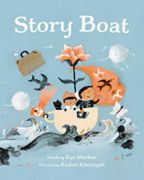
When you have to leave behind almost everything you know, where can you call home? Sometimes home is simply where we are: here. A imaginative, lyrical, unforgettable picture book about the migrant experience through a child’s eyes