
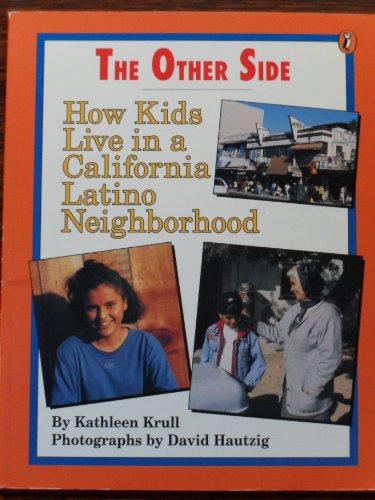
 Provides a brief look at three Latino children who live in the border town of Chula Vista. The book covers the lives of three Latino children who have successfully adapted to a new culture and language while still maintaining close ties to family members in Mexico.
Intermediate (ages 9-14)
Material appropriate for intermediate age groups
Star of Luis
When Luís’s father joins the army shortly after the start of World War II, Luís’s entire life changes. His mother decides to return to the dusty New Mexican village where she and her husband grew up. In Los Angeles, Luís had struggled to find a place in his ethnically diverse neighborhood and had been intimidated into ending a close friendship with a Jewish boy. In Las Manos, everyone is Hispanic and Catholic like Luís, but the way of life seems backward and slow. Luís and his mother stay in a cramped bungalow with his dying grandfather and sullen grandmother, and Luís must share a bed with his uncle, a priest. Then, just as Luís begins to feel more comfortable in Las Manos, he learns an settling fact-his family is not Catholic after all. They are Jewish, a secret that has been kept for generations. Angry and confused, Luís realizes he must confront his feelings about family, religion, and friends, and ultimately make his own decision about who he is. Glossary of Spanish words.
Tales Our Abuelitas Told: A Hispanic Folktale Collection
Once upon a time, in a land far away…These stories have journeyed far — over mountains, deserts, and oceans — carried by wind, passed on to us by our ancestors. Now they have found their way to you.A sly fox, a bird of a thousand colors, a magical set of bagpipes, and an audacious young girl…A mixture of popular tales and literary lore, this anthology celebrates Hispanic culture and its many roots — Indigenous, African, Arab, Hebrew, and Spanish.F. Isabel Campoy and Alma Flor Ada have retold twelve beloved stories that embody the lively spirit and the rich heritage of Latino people.The work of four leasing Latino artists and illustrators highlights this unforgettable collection.
The Boys of San Joaquin
Paolo calls Rufus “a Mack truck with no one driving.” Rufus is the O’Neil family dog, and he shows up one morning with part of a twenty-dollar bill in his teeth.Paolo, age twelve, figures that there must be more where that bill came from, and since his cousin Billy needs to repair a bent wheel on his bike, there’s a reason for looking. He, Georgie, and Billy end up in the monsignor’s garden behind the Cathedral of San Joaquin, but it’s not exactly treasure they find, it’s a hand that shoots out of the undergrowth to grab Paolo’s neck. The search for the stash leads the boys — sometimes scared spitless — on many a byway around Orange Grove City, California, in the summer of 1951. And onto the byway of conscience.”Suppose you found a treasure. Couldn’t you keep it?” Paolo asks his uncle. “I mean, say you know who it belongs to, and they probably need it….But when you find it, nobody has it. Isn’t nobody’s property in particular, then,” he reasons. “Well, maybe somebody has it, but it isn’t theirs. It would be yours, wouldn’t it?”No answer. “How in the heck is a guy supposed to be somebody in this world without any money?”
Projects About the Spanish West (Hands-On History)
 Social studies projects reflecting Spanish culture on the American West.
Chicken Foot Farm
On the eve of World War II, young Alejandro comes of age on his family’s South Texas farm, known as Chicken Foot Farm because of how his mother marks her chicks. “Mama held the chick against her breast and splayed its left foot between her thumb and index finger. With her free hand she… quickly cut off the end of the chick’s shortest toe.” Rich with the customs and traditions of rural, Mexican-American life, Chicken Foot Farm depicts a multi-generational family in flux as change crawls relentlessly toward their land and lifestyle. As the seasons–and loved ones–come and go and misfortunes befall the family, Alejandro learns the lessons of life: the importance of family, honesty, hard work, and compassion. When the kitchen burns down one night, Alejandro feels they have lost something integral to their family unity. But his father promises they will build another kitchen, the new one better than the old. As Abuela Luciana ages, she begins to behave erratically, burning tortillas, forgetting to add water to the beans she is cooking, and even disappearing from the farm. She is certain someone has cursed her–put mal de ojo on her. How can the family cure her when she is the curandera, the one who has always taken care of them? Most importantly, Alejandro works hard to win his father’s approval, even though Papa generally ignores him in favor of the eldest son, Ernesto, who Papa says will inherit the farm. When Ernesto joins the Army, the family must face the possibility that he may not return as the entire country is thrown into the uncertainty of war. Following the attack on Pearl Harbor, young Alejandro notices something new in his family’s kitchen: a framed United States flag now hangs on the wall. “It’s something I can do for the war,” his Abuela Luciana tells him. Not understanding, she explains to him, “I can remind people that we are Americans.” In these poignant images of a time and place long gone, Anne Estevis sketches a tight-knit, Mexican-American community on the cusp of a new way of life as tractors replace mules and modern science competes with superstitious beliefs.
Fitting In
Written with deep understanding and compassion, these are the bittersweet tales of young Cuban immgrants adjusting to life in the United States as they cross the threshold into young womanhood.
Help Wanted: Stories
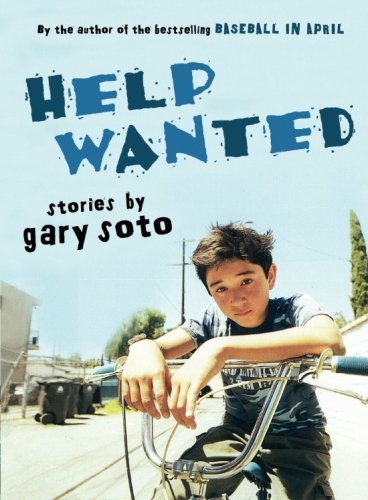 With real wit and heart, Gary Soto takes readers into the lives of young people in ten funny, heartbreaking tales. Meet Carolina, who writes to Miss Manners for help not just with etiquette but with bigger messes in her life; Javier, who knows the stories his friend Veronica tells him are lies, but can’t find a way to prove it–and many other kids, each caught up in the difficulties of figuring out what it means to be alive.
Mercy on These Teenage Chimps
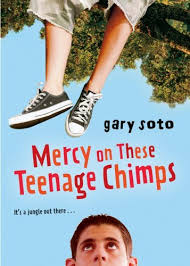 At age 13, best friends Ronnie and Joey suddenly feel like chimps–long armed, big eared, and gangly–and when the coach humiliates Joey in front of a girl, he climbs up a tree and refuses to come down. Gary Soto tells a touching story about friendship, understanding and the painful insecurities of being 13.
Joan Baez: Folksinger for Peace (Great Hispanics of Our Time)
 A biography of the Mexican American folk singer who became a political activist and who wrote and sang songs that inspired people to make the world better.