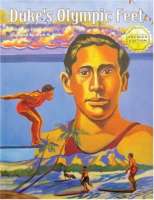
Duke’s Olympic Feet

Duke Kahanamoku was the twentieth century’s top waterman, and is known as the “father of international surfing.” The first Hawaiian to win an Olympic gold medal, Duke represented the United States in the Olympic Games in 1912, 1920, 1924 and 1932, winning gold, silver and bronze medals. Born in 1890, Duke grew up next to the ocean in Waikîkî. After school, he and his sister and brothers would hit the water. “I was only happy when I was swimming like a fish,” Duke said. Duke and the other beach boys gathered under a hau tree in Waikîkî. They rode the waves at Castles, a prime surf spot, on their sixteen-foot solid wooden surfboards. Years of swimming, surfing and canoe paddling made Duke a fine athlete. He had a strong body, long arms, powerful legs and his hands were said to be as big as buckets. Some claimed he had feet as big as fins and could steer a canoe with his feet alone. Duke knew that he was a very fast swimmer and he trained constantly. He said that God had given him a gift and a whip. “The whip,” he said with a grin, “is to flog myself into getting the most out of the gift.” He felt that, just maybe, he could be a champion and win Olympic gold for Hawai‘i. His chance came August 12, 1911, at Alakea Slip in Honolulu Harbor, when he demolished the world amateur record for the 100-yard freestyle. His excitement was crushed when mainland AAU officials refused to believe his time. “What are you using for stopwatches over there in Hawai‘i?” they asked. “Alarm clocks?” The AAU officials doubted that a virtually untrained swimmer could break a world record. It was up to Duke to prove he could go up against the world’s fastest swimmers and beat them. Along with his athletic accomplishments, Duke is remembered for his concern for others, humility in victory, courage in adversity and good sportsmanship.

Take a closer look at Duke’s Olympic Feet as examined in WOW Review.
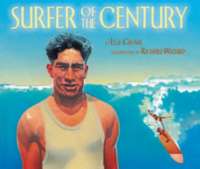
Surfer of the Century: The Life of Duke Kahanamoku

The true story of Hawaiian Duke Kahanamoku, six-time Olympic swimming champion and legendary surfer who popularized surfing around the world.

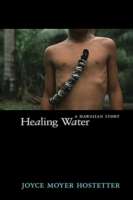
Healing Water: A Hawaiian Story

When thirteen-year-old Pia is sent to Hawaii’s leprosy settlement on Molokai Island in the 1860s, he chooses anger and self-reliance as his means of survival, but the faithful example of other villagers and one remarkable priest threaten to destroy his desire for revenge.

Featured in Volume I, Issue 3 of WOW Review.

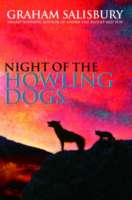
Night of the Howling Dogs

Dylan’s Scout Troop goes camping in Halape, a remote spot below the volcano on the Big Island of Hawaii. The only thing wrong with the weekend on a beautiful, peaceful beach is Louie, a tough older boy. Louie and Dylan just can’t get along. That night an earthquake rocks the camp, and then a wave rushes in, sweeping everyone and everything before it. Dylan and Louie must team up on a dangerous rescue mission. The next hours are an amazing story of survival and the true meaning of leadership.

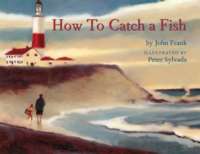
How to Catch a Fish

Thirteen linked verses and handsome, mood-drenched paintings show how we catch fish from New England to the Arctic, to Japan and Namibia and beyond. This lovely picturebook about fishing, geography, people and customs, and the bond between parent and child fishing together will appeal to everyone who’s cast a line in the water.

Plantation Child and Other Stories

These vividly told tales of plantation life from decades past center around the lives of Marita Kim and her four younger brothers and sisters. The children experience many hardships growing up poor and motherless in a Korean camp in Hawaii, but their stories are full of adventure. In “Joe and the White Dog,” Joe takes Little Sister exploring and loses her… until a mysterious white-haired woman and her friendly dog appear to help. In “The Little People,” fearless six-year-old Puni searches for menehune to grant her wish for a new doll. The stories also provide a poignant look at the family’s daily struggles. In “Plantation Child” we see, through the eyes of Marita, the sacrifices made to pay for a pair of new shoes, the need for thrift and hard work to make ends meet. In “The Pineapple Cannery” we share in Marita’s excitement as she begins a new life working in Honolulu. The last story, “Abuji,” is a tender portrait of the long-widowed father, reminiscing about his youth and his return journey to Korea. Moving from child to child, from story to story, Eve Begley Kiehm brings to life a formative period in the history of Korean Americans in Hawaii.

More Bones

From China to Egypt, and Spain to Hawaii, people have gathered for generations to listen to spooky stories that make the back of their necks prickle.

Dog-of-the-Sea-Waves

Manu, one of five brothers who are the first humans to set foot on Hawaii, is unhappy until he saves the life of a strange creature he calls Dog-of-the-Sea-Waves, and they become fast friends. Includes facts about Hawaii and the unique plants and animals found there.

The Fish And Their Gifts

The Fish and their gifts is a student-created product. Written and illustrated by ten middle and high school students, this book is the result of an interdisciplinary book-publishing project integrating English Language Arts, Fine Arts, Hawaiian Language, Hawaiian Studies, and Science and Technology.

The story is told in both English and Hawaiian about Hawaiian sea creature’s strength.