
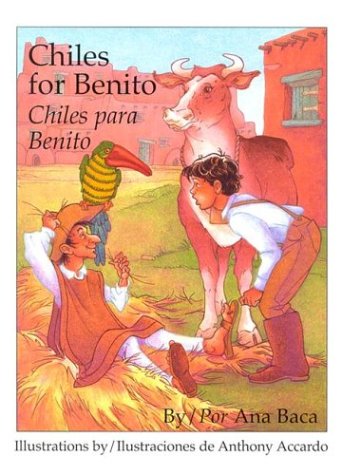
 This charming bilingual fable explains the origins of the all-important chile Chiles ristras adorn the kitchen and dishes all over New Mexico. In the winter, when the nights grow longer and the winds blow stronger, chiles season meats and stews bringing New Mexico spice to every hungry taste bud. But chiles didn’t always grow in New Mexico, and Ana Baca tells a special fable about Benito and the chiles that crawled all over his family’s simple homestead. Benito’s mother sends him to the country fair in the hopes of their cow winning the first place prize. This would give them money to buy some seeds for the crop, but the cow misbehaves and they must leave the fair. Suddenly, Benito is stopped by a mysterious man with a peculiar bird on his shoulder. The man offers Benito some powerful seeds in exchange for his cow, which Benito quickly accepts. But when only uncontrollable weeds grow from the ground, Benito begins to feel foolish. The neighboring farmers begin to complain that the relentless weeds are killing their crop. How will the community survive? Will the rapidly growing weeds ever bear fruit for Benito?
United States
Materials from United States of America
Conversations with Contemporary Chicana and Chicano Writers
 Hector A. Torres conducted these interviews with today’s popular Chicano/a writers, asking each about language and life between languages, about the creative drive that has guided them in their craft and commits them to their art. In sharing their responses, Torres reveals a brief biography of each author and a concise examination of their writings. Taking their stories and essays individually and collectively, Torres explains how each author reiterates issues that have concerned Mexican Americans since at least 1848. Chicano/a authors know that an abundance of politics can spoil a story, as can too little. The writers included here span historical terrain, first, under the shadow of Manifest Destiny and, then, under the America’s imperial sovereignty stance. Interviewees include Rolando Hinojosa (“I Reflect the Way Valleyites Act and React”), Arturo Islas (“I Don’t Like Labels and Categories”), Erlinda Gonzales-Berry (“On the New Mexican Borderlands”), Gloria Anzaldúa (“The Author Never Existed”), Ana Castillo (two separate interviews), Sandra Cisneros (two separate interviews), Pat Mora (“I Was Always at Home in Language”), Richard Rodriguez (“I Don’t Think I Exist”), Demetria Martinez (“To Speak as Global Citizens”), and Kathleen Alcalá (“To Tell the Counternarratives”).
Estrella’s Quinceañera
For as long as Estrella Alvarez can remember, her mother has been planning to throw her an elaborate quinceañera for her fifteenth birthday — complete with a mariachi band, cheesy decorations, and a hideous dress. Just thinking about her quince makes Estrella cringe. But her mother insists that it’s tradition. Estrella has other things on her mind, anyway — like dating Speedy. Does it matter that her new friends — and her parents — would never approve of aguy from el barrio? Estrella’s almost fifteen and wants to start making her own decisions. But is she ready to find out who she is — and who she really wants to be?
Famous Mexican Americans: 2
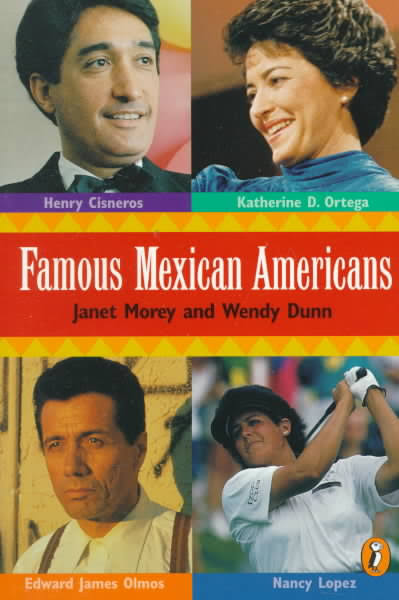 Discusses the accomplishments and contributions to society of fourteen Mexican Americans, representing a variety of professions.
Manuel and the Lobsterman
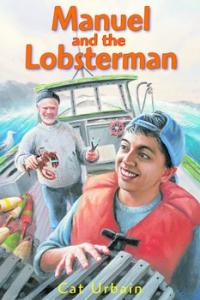 Manuel, a Puerto Rican thirteen-year-old from New Haven, Connecticut, goes to Maine with his mother and new stepfather for the summer, where he learns to work on a lobster boat and to get along with the townsfolk.
Jonron!
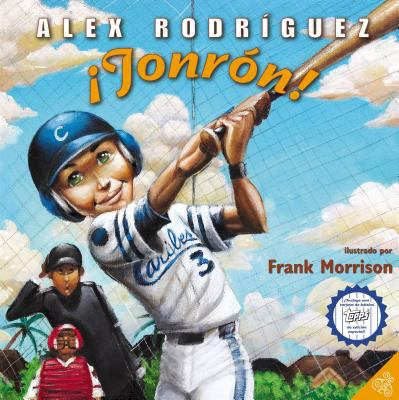 A story about a kid who wants to be the best baseball player ever but just keeps messing up so he wakes up earlier and tries harder just to become the best and win the championship game. This book is written by Alex Rodriquez, a Yankee baseball player.
Julian Rodriguez Episode One
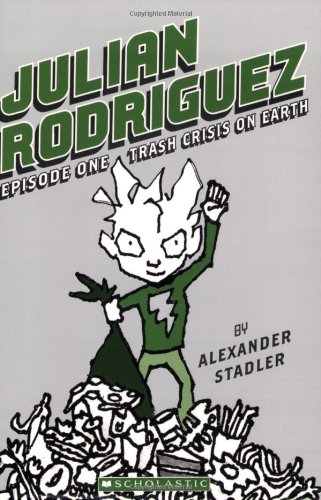 Julian Rodriguez is on a mission for the Mothership. He’s been sent to Earth to study human lifeforms and their bizarre habits–from their disgusting diet (orange sticks named carrots, flavorless liquid called water, and the revolting substance known as vegi-dogs) to their repressive treatment of their young (forcing them to carry out menial tasks known as chores, withholding access to the great cultural masterpieces called cartoons). When Julian’s Maternal Unit assigns a hideous task, it’s nearly too much for the hardened space veteran to bear–but he finds his courage at last. * “First in what readers will hope will be a robust series, this hybrid of fiction and graphic novel dusts off a favorite conceit with a slick swipe of edgy visuals and tart commentary….It’s impossible to read this without laughing.” — Publishers Weekly (starred review)
Nepantla: Essays from the Land in the Middle
As a Latina educator, poet, mother, lecturer and native of El Paso, Texas, Pat Mora is a denizen of nepantla—a Nahuatl word meaning “the land in the middle.” In her first collection of essays, Mora negotiates the middle land’s many terrains exploring the personal issues and political responsibilities she faces as a woman of color in the United States. She explores both the preservation of her own Mexican American culture and her encounters with other cultures.
Noche de Humo
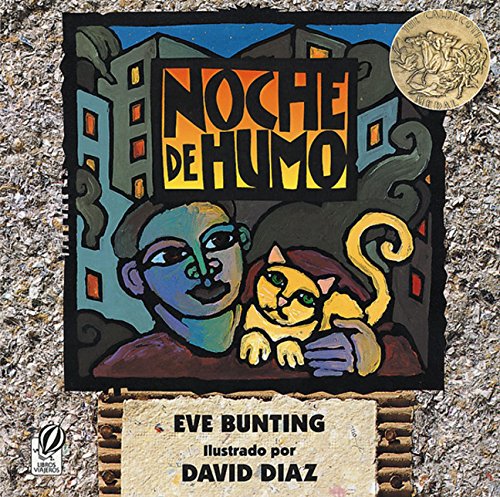 Eve Bunting’s heartfelt story and David Diaz’s dramatic illustrations create a compelling child’s-eye view of urban violence. A young boy and his mother are forced to flee their apartment during a night of rioting in Los Angeles. Fires and looting force neighbors–who have always avoided one another–to come together in the face of danger and concern for their missing pets. David Diaz was awarded the Caldecott Medal for his bold acrylic paint and photo-collage illustrations.
Triple Banana Split Boy / El Nino Goloso
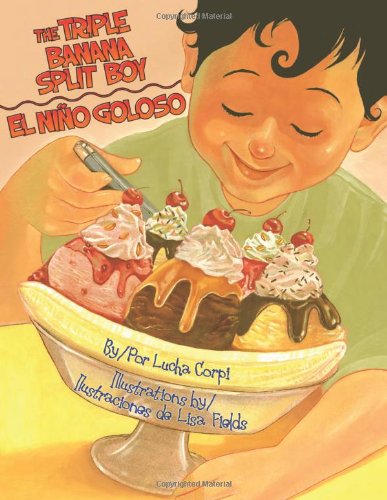 ”How come you can have sweets and I can’t?” Enrique asks the hummingbirds as they flutter over the flowers in the garden. His craving for sugar is getting out of control, and his father has forbidden him to eat anything sweet. Enrique’s birthday is coming up and he won’t be allowed to help his grandma with her baking. It’s not fair! Enrique’s cravings multiply by the minute. Even numbers in his math book start to look like yummy desserts. His life is over! The next day, though, he comes up with an ingenious plan to outwit his father. Unfortunately, his mother soon catches on. But she has a plan of her own. On Mondays and Fridays only, after school, Enrique may have any dessert he likes, but none during the rest of the week. What a sweet deal!On his first outing with his mother, Enrique orders a huge triple banana split, with strawberry, chocolate and vanilla scoops of ice cream, nuts, sprinkles and chocolate syrup. Later that night, Enrique’s stomach aches, and El Coco, a fearsome creature with a huge mouth and sticky hair, haunts his dreams. Enrique’s mother wonders if he will ever learn to eat in moderation. Will he be able to bake with Grandma? And what about having a special treat on his birthday? Lucha Corpi’s poetic prose is combined with Lisa Field’s enticing illustrations in this engaging story that will resonate with kids and their parents as they struggle to balance healthy eating habits with the natural desire for sweets.