
As Himiko traverses ancient Japan in order to free enslaved members of her clan, she encounters members of many other tribes and emerges as the leader who will unify them.
Intermediate (ages 9-14)
Material appropriate for intermediate age groups
The Hunting, Book One: Z. Rex
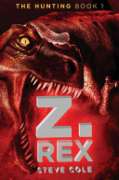
Jurassic Park meets virtual gaming in a blockbuster new thriller! You’re 14 and find yourself on your own. Your father, who has developed the worlds cutting edge research on virtual electronic game-playing, has been missing for weeks. And suddenly you’re being hunted by men with guns, your picture is on the news, and, worst of all, something seemingly impossible is chasing youa savage, man-eating dinosaur. How can that be? Why is everyone trying to capture you? And what is your strange connection with this 21st-century prehistoric monster? Steve Cole has created an absurdly gripping and kid-friendly thriller that will capture imaginations. If Jurassic Park were to meet Alex Rider, the result might well be this irresistible new novel.
Gossamer
While learning to bestow dreams, a young dream giver tries to save an eight-year-old boy from the effects of both his abusive past and the nightmares inflicted on him by the frightening Sinisteeds.
Nobody Knows
It’s autumn in Tokyo, and twelve-year-old Akira and his younger siblings, Kyoko, Shige and little Yuki, have just moved into a new apartment with their mother. Akira hopes it’s a new start for all of them, even though the little ones are not allowed to leave the apartment or make any noise, since the landlord doesn’t permit young children in the building. But their mother soon begins to spend more and more time away from the apartment, and then one morning Akira finds an envelope of money and a note. She has gone away with her new boyfriend for a while. Akira bravely shoulders the responsibility for the family. He shops and cooks and pays the bills, while Kyoko does the laundry. The children spend their time watching TV, drawing and playing games, wishing they could go to school and have friends like everyone else. Then one morning their mother breezes in with gifts for everyone, but she is soon gone again. Months pass, until one spring day Akira decides they have been prisoners in the apartment long enough. For a brief time the children bask in their freedom. They shop, explore, plant a little balcony garden, have the playground to themselves. Even when the bank account is empty and the utilities are turned off and the children become increasingly ill-kempt, it seems that they have been hiding for nothing. In the bustling big city, nobody notices them. It’s as if nobody knows. But by August the city is sweltering, and the children are too malnourished and exhausted even to go out. Akira is afraid to contact child welfare, remembering the last time the authorities intervened, and the family was split up. Eventually even he can’t hold it together any more, and then one day tragedy strikes…
Calvin Coconut: Extra Famous

Calvin and his friends have the opportunity to earn some money by appearing as extras in a zombie movie being filmed on a nearby beach.
Poseidon: Earth Shaker (Olympians)
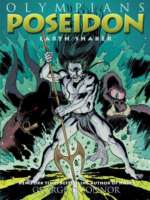
In the fifth installment of the Olympians series of graphic novels, author/artist George O’Connor turns the spotlight on that most mysterious and misunderstood of the Greek gods, Poseidon: Earth Shaker. Thrill to such famous myths as Theseus and the Minotaur, Odysseus and Polyphemos, and the founding of Athens—and learn how the tempestuous Poseidon became the King of the Seas.
Beyond the Moongate
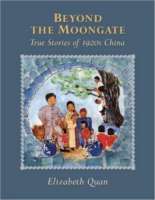
MOONGATES DOTTED THE LANDSCAPE OF OLD CHINA. Ancient Chinese architects had sculpted stone piled on sculpted stone to form round doorways, with the spiritual symbolism of the full moon. To step through one of these doorways was to step into a world of peace and happiness…
And so it was in the 1920s that the Lee King family – father, mother, and six children, aged ten months to seven years – traveled from their home in Canada, across the Pacific Ocean, to inland China. There, they had the opportunity to step beyond the moongate into a land not yet touched by modern warfare or political unrest.
The story of the moongate, tells of the two “golden” years the family spent with Grandmother in a remote village in the south, which hadn’t changed for centuries.
Step inside and live the long lazy days of a China forever gone. The moongate beckons…
Mouse Bird Snake Wolf
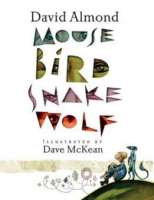
The gods have created a world that is safe and calm and rather wonderful. They have built mountains, forests, and seas and filled the world with animals, people, and unnamed beasts. Now their days are fat with long naps in the clouds, mutual admiration, and tea and cake. But their world has gaps in it filled with emptiness, gaps that intrigue Harry, Sue, and little Ben until they begin to see what might fill them. One by one the children conjure, from twigs and leaves and stones, a mousy thing, a chirpy thing, and a twisty legless thing. But as the children’s ideas grow bolder, the power of their visions proves greater and more dangerous than they, or the gods, could ever have imagined. Is it possible to unmake what’s been made?
My Name Is Parvana

On a military base in post-Taliban Afghanistan, American authorities have just imprisoned a teenaged girl found in a bombed-out school. The army major thinks she may be a terrorist working with the Taliban. The girl does not respond to questions in any language and remains silent, even when she is threatened, harassed and mistreated over several days. The only clue to her identity is a tattered shoulder bag containing papers that refer to people named Shauzia, Nooria, Leila, Asif, Hassan — and Parvana. In this long-awaited sequel to The Breadwinner Trilogy, Parvana is now fifteen years old. As she waits for foreign military forces to determine her fate, she remembers the past four years of her life. Reunited with her mother and sisters, she has been living in a village where her mother has finally managed to open a school for girls. But even though the Taliban has been driven from the government, the country is still at war, and many continue to view the education and freedom of girls and women with suspicion and fear.
Keeping Score
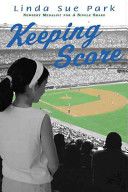
In Brooklyn in 1951, a die-hard Giants fan teaches nine-year-old Maggie, who is a “Bums” (Dodgers) fan, how to keep score which creates a special friendship between them.
See the review at WOW Review, Volume 5, Issue 3.