
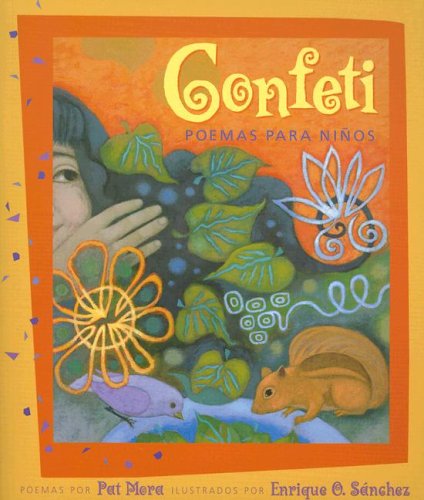
 In this joyful and spirited collection, award-winning poet Pat Mora and fine artist Enrique O. Sanchez celebrate the vivid landscape of the Southwest and the delightful rapport that children share with the natural world. Through language that resounds with the harmony of both English and Spanish, Confetti is also an anthem to the power of a child’s imagination and pride.
Genre
Catalog sorted by genre
Count on Culebra: Go from 1 to 10 in Spanish
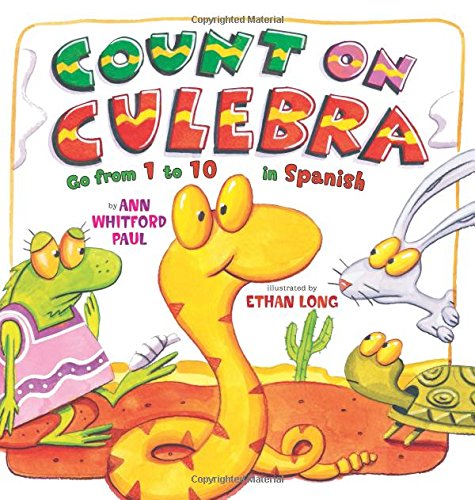 A companion to the popular Manana, Iguana that teaches how to count in spanish. When Iguana stubs her toe, Doctor Culebra comes to the rescue. But his suggestions sound a little loco to everyone else. How will tying un rolling pin and dos kettles to Iguana’s tail make her better? And more importantly, will Iguana feel well enough to make her cactus butter dulces? The extremely popular “Manana, Iguana” has sold and reprinted quickly, and Ann Whitford Paul and Ethan Long’s previous titles have received much praise.
Snapshots from the Wedding
Maya attends a family wedding and captures it all on film, from her cousin getting rice in his eye to the cake that tasted as delicious as it looked, in a beautifully illustrated tale of a special family day.
Growing Up with Tamales/Los Tamales De Ana (Spanish Edition)
“My name is Ana. Every year, my family makes tamales for Christmas. This year, I am six, so I get to mix the dough, which is made of cornmeal. My sister Lidia is eight, so she gets to spread the dough on the corn husk leaves. I wish I was eight, so that my hands would be big enough to spread the dough just right–not too thick and not too thin.” And so the years pass, and Ana turns eight, ten, twelve, fourteen, sixteen. But every year, big sister Lidia is always two years older. Ana envies her elder sibling and wishes she could do what Lidia does: put just the right amount of meat inside the tamales and roll them up; steam the tamales without scalding herself with the hot, hot steam; chop and cook the meat for the tamales without cutting or burning her hands. When she turns eighteen, though, Ana knows she will keep making tamales and she will be able to do all of the steps herself in her very own factory. When Christmas comes around, Ana will deliver tamales to all of her customers around the world, in delivery trucks that say “Ana’s Tamales.” And maybe Ana will even let Lidia work for her. Gwendolyn Zepeda’s rhythmic prose is combined with April Ward’s bright illustrations to create an affectionate and amusing story about sibling relationships that introduces an important Hispanic holiday tradition–making tamales!
The Too Precious Child
 Exposes the patterns and motives that lead parents to become too involved in their children’s lives, assesses the effects of their behavior on the family, and offers solutions to this problem
Henry Cisneros
 A biography of the Mexican-American mayor of San Antonio, Texas, who became the first Hispanic mayor of a major United States city in 1981.
Juan And The Jackalope: A Children’s Book In Verse
When Rosita, the loveliest gal in the Pecos River Valley, offers her delicious rhubarb pie as first prize for the Great Grasshopper Race, a thousand love-struck vaqueros line up for the competition. Of course everyone believes that the legendary cowboy Pecos Bill, riding his giant grasshopper, Hoppy, is a shoo-in for the grand prize. Sure enough, Bill and Hoppy give an impressive performance, crisscrossing the Southwest in a raucous ride. But young Juan, who is hopelessly in love with Rosita, astonishes them all when he and Jack the Jackalope take a miraculous ride around the world and across the Milky Way. The daring pair return, covered in stardust, to claim the beautiful Rosita and her delicious pie. Set in New Mexico, Anaya’s fanciful story, coupled with Amy Cordova’s vivid illustrations, brings the tradition of Southwestern tall tales to a new generation of young readers.
Red Hot Salsa: Bilingual Poems On Being Young and Latino in the United States
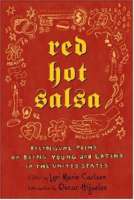
A collection of English and Spanish bilingual poems from the editor of Cool Salsa.
Chicken Foot Farm
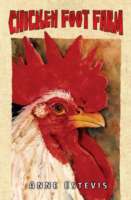
On the eve of World War II, young Alejandro comes of age on his family’s South Texas farm, known as Chicken Foot Farm because of how his mother marks her chicks. “Mama held the chick against her breast and splayed its left foot between her thumb and index finger. With her free hand she… quickly cut off the end of the chick’s shortest toe.” Rich with the customs and traditions of rural, Mexican-American life, Chicken Foot Farm depicts a multi-generational family in flux as change crawls relentlessly toward their land and lifestyle. As the seasons–and loved ones–come and go and misfortunes befall the family, Alejandro learns the lessons of life: the importance of family, honesty, hard work, and compassion. When the kitchen burns down one night, Alejandro feels they have lost something integral to their family unity. But his father promises they will build another kitchen, the new one better than the old. As Abuela Luciana ages, she begins to behave erratically, burning tortillas, forgetting to add water to the beans she is cooking, and even disappearing from the farm. She is certain someone has cursed her–put mal de ojo on her. How can the family cure her when she is the curandera, the one who has always taken care of them? Most importantly, Alejandro works hard to win his father’s approval, even though Papa generally ignores him in favor of the eldest son, Ernesto, who Papa says will inherit the farm. When Ernesto joins the Army, the family must face the possibility that he may not return as the entire country is thrown into the uncertainty of war. Following the attack on Pearl Harbor, young Alejandro notices something new in his family’s kitchen: a framed United States flag now hangs on the wall. “It’s something I can do for the war,” his Abuela Luciana tells him. Not understanding, she explains to him, “I can remind people that we are Americans.” In these poignant images of a time and place long gone, Anne Estevis sketches a tight-knit, Mexican-American community on the cusp of a new way of life as tractors replace mules and modern science competes with superstitious beliefs.
Call Me Consuelo
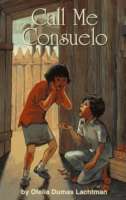
Intrigue and danger weave a web around young Consuelo as she is thrust into a new life in unfamiliar surroundings and a real life mystery that begs to be resolved.