
 Drinking and fighting are nothing new in Tyrone’s house, but this time, his dad leaves and doesn’t come back. Tyrone’s anger at his father’s desertion finds an outlet through violent eruptions at school. Life at home is no better as his mother begins working a night job to pay the bills and expects him to take care of his siblings. Instead, he starts partying with older kids, skipping school, and sneaking home in the early morning hours. But when his younger brother is caught stealing candy, Tyrone realizes that he will have to take on the responsibility whether he wants to or not. Settling in to his new role, Tyrone is furious when he learns that his father wants to come home. He just doesn’t understand how his mother can forgive his father so easily. With the help of his friends and counselor, Tyrone begins to deal with his feelings of anger and betrayal as the son of an alcoholic, absentee father. This book is the seventh novel in Gloria Velasquez’s popular Roosevelt High School series, which features a multiracial group of teenaged students who must individually confront social and cultural issues (such as violence, sexuality, and prejudice) that young adults face today.
United States
Materials from United States of America
Someone Like Summer
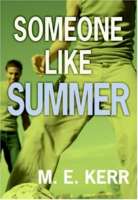
Annabel first sees him playing soccer near her house. His name is Esteban—she sees it on the back of his team shirt. He notices her, smiles, then looks back over his shoulder at her again.
It is the beginning of summer in the resort town of Seaview. It is also the start of a romance between a young Colombian who came to town to work and the daughter of a local contractor whose crews are entirely Latino—new immigrants who are changing the face of Seaview.
This is the summer of war in Iraq, and of Hurricane Katrina. But in Seaview there are other concerns. In Annabel’s house her new boyfriend is at the top of the list. And Esteban’s sister has harsh words for his choice of a girlfriend.
M. E. Kerr weaves a compelling story of star-crossed love and a small-town problem of nationwide significance.
The Corn Woman: Stories And Legends Of The Hispanic Southwest
The culture, history, and spirit of the Hispanic Southwest are celebrated through 45 fascinating stories and legends from the region. From ancient creation myths of the Aztecs and traditional tales of Spanish colonialists to an eclectic sampling of the work of modern Latino storytellers, this book provides a rich tapestry of both obscure and well-loved stories-religious stories; animal tales; stories of magic, transformation, and wisdom; and chistes (short comic tales). Fifteen tales are also presented in Spanish.
Little Night

As the long day comes to an end, Mother Sky fills a tub with falling stars and calls, “Bath time for Little Night!” Little Night answers from afar, “Can’t come. I am hiding and you have to find me, Mama. Find me now!” Where could Little Night be? Down a rabbit hole? In a blueberry field? Among the stripes of bees? Exquisitely painted and as gentle as Little Night’s dress crocheted from clouds, this is a story to treasure.
Let’s Eat!/A Comer! (My Family: Mi Familia)

It’s dinnertime. Look at all the food! Es la hora de cenar. ¡Cuánta comida! There are beans, tortillas, Hay frijoles, tortillas, cheese, and even a green salad. queso y hasta una ensalada de lechuga. Enough for the whole family. Suficiente para toda la familia. Let’s sit down and enjoy it together. Vamos a sentarnos y disfrutarla juntos. Let’s eat! ¡A comer! This first book in the new bilingual My Family/Mi familia series will charm readers with its close-knit family—a family that is grateful for its many blessings. Éste es el primer libro de la nueva serie My Family/ Mi familia. Los lectores quedarán encantados con esta familia unida que se siente agradecida por todas sus bendiciones.
A Piece Of My Heart/Pedacito De Mi Corazon: The Art Of Carmen Lomas Garza
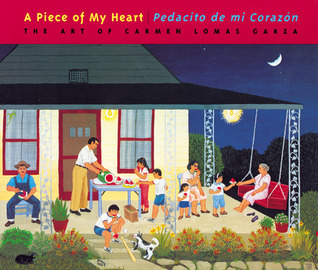 The thirty-seven works of art, twenty-four in full color, presented in A Piece of My Heart take us into the heart of one of the most distinguished painters of Chicano life. In a career that spans twenty years, Carmen Lomas Garza has depicted the cherished traditions and harsh struggles of Chicano culture. From Grandparents Cutting Cactus to Felino’s Breakdancers, Lomas Garza’s bright, colorful images capture the beauty and texture of daily life among families, friends, and neighbors in southern Texas.
Alicia’s Treasure
Alicia’s Treasure is the delightful tale of a young girl’s magical, fun-filled journey of discovery to the sea shore.
Benito’s Bizcochitos: Los Bizconchitos De Benito
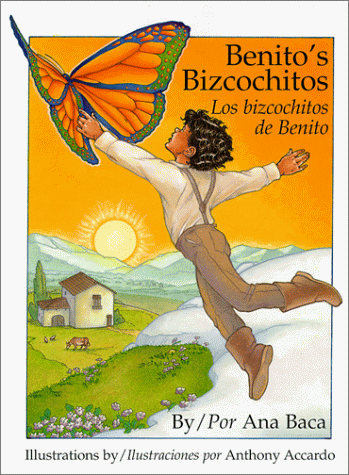 This bilingual fairy tale for children ages 4 to 8 relates the story of Benito, who runs away from home only to learn that the rest of the world isn’t nearly as friendly as his family’s farm.
Call Me Consuelo
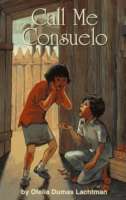
Intrigue and danger weave a web around young Consuelo as she is thrust into a new life in unfamiliar surroundings and a real life mystery that begs to be resolved.
Case Of The Pen Gone Missing: A Mickey Rangel Mystery / El Caso De La Pluma Perdida: Coleccion Mickey Rangel, Detective Privado
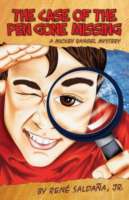
When Toots Rodriguez approaches Mickey on the playground, he knows something is up. Toots, the prettiest girl in the fifth grade, never talks to Mickey, not even when they’re assigned to work together on a class project. But Toots has come to Mickey because she’s in trouble, and he’s a detective. The real deal. He has a badge and a certificate after completing an online course two years ago. ”You have to believe me, Mickey. I didn’t take that pen. I didn’t.” When Toots shines her big green eyes on him and insists repeatedly that she’s innocent, Mickey’s intuition tells him to run fast in the opposite direction. But he’s a sucker for a pretty girl, so he takes on the case of the missing pen. Rumor has it that Toots stole Eddy’s pen. It’s not just any old pen; it’s his dad’s pen. It has the White House logo on it. Eddy’s father, a senator from South Texas, got the pen from the President of the United States when he visited the White House last year. As Mickey begins his investigation, though, all the clues point to Toots and her newly ex-boyfriend as the primary suspects. The first book in The Mickey Rangel Mystery series for intermediate readers, author and educator Rene Saldana, Jr. has crafted another appealing book for kids, and his wise-cracking, smart protagonist will appeal to even the most reluctant readers.