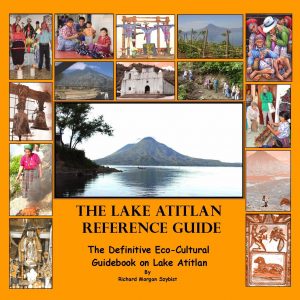
 The Lake Atitlan Reference Guide is an eco-cultural guide to the lake identified by Aldous Huxley (Brave New World) as “the most beautiful lake in the world.” Atitlan is a volcanic caldera, located at 5,000 ft above sea level in the Mayan highlands of Guatemala. Atitlan means “at the water.” It is a fusion of simple Nahuatl words that belies the complexity of the entity it identifies. Lake Atitlan is both a place and an event in motion. Its life incorporates the visually stunning character of one of nature’s most ambitious creations and the extraordinarily diverse cultural character of the human life that the Lake has drawn to its shores. Atitlan was born violently, long ago, probably before the emergence of man here. Scientists still debate the exact nature of its birth, an event which created a nearly circular depression of 11 miles in diameter, 95 square miles of area, and over 1,000 feet deep. The cause of this huge cavity, a chain of events which began with an immense eruption, produced a unique microenvironment that has been drawing wanderers to the Lake’s shores for at least thousands of years. Cultures have clashed to control it. Vagabonds have been absorbed by it, laid down roots, and quit “moving on.” Traveling notables have been overwhelmed by its beauty and written about it in the loftiest of terms. Any effort to empirically order the kaleidoscope of its elements is ultimately challenged by the spiritual and physical immensity of the subject. This work makes no such attempt. What is offered here instead is a summary of the Lake environment in terms of its physical location and nature, its cultural history, and its contemporary political and socioeconomic life. The text is supported by more than 100 quality fotos (most in color) and a variety of other illustrations.