A bilingual picture book that will be #1 this spring! From a talented team, this hilarious tale of competition run amok is told with a sprinkling of Spanish and a heaping spoonful of charm. Which is better, brains or brawn? In a small village, Hercules is known for his great strength and Socrates for his keen intelligence. Whenever the villagers have a problem, they go to one or the other for help. Each man believes that he is the most important person in town. And the two fight about it constantly. Who, their neighbors wonder, will resolve the question that instigates all this bickering? The villagers realize they must settle the argument once and for all by finding out who is “número uno.” They devise a clever test, and Hercules and Socrates, each sure he will win, go along with it. The answer is a surprise for everyone “I came up with the idea for Número Uno in sixth grade when the class was asked to write fables. I thought that these two characters, one with outstanding intelligence and one with exceptional brawn, would together create an entertaining story. It could also carry a valuable lesson, as fables do. The story was originally set in China, but to me it is universal. We later decided to change to a Spanish-speaking setting, which I am more familiar with. “I grew up bilingual, speaking English and Spanish, and have visited many Latin American countries, including going to school there for a short while. I’m now sixteen years old and am enjoying living in Seattle. I spend much of my free time going to the nearby mountains (like Hercules and Socrates do in the book), in my case to snowboard. I also create my own stories through taking photographs, a few of which have now been published. I stay busy with playing baseball and going to high school. “As we wrote the book, the story stayed essentially as I originally had it, though we went through seemingly endless numbers of revisions and ended up changing details in the process. Writing a book with your dad is definitely not the easiest of tasks. At some points we reminded ourselves of the bickering characters in the story. Ultimately we were able to work together to create what I hope is a book you’ll enjoy.”—Alex Dorros on the creation of Número Uno with his father Arthur Dorros
North America
Sundays on Fourth Street / Los Domingos En La Calle Cuatro
”My cousin Pepe combs my hair back just like his, and Aunt Pilar laughs. Then she slides her red lipstick across my lips, but Mama wipes it off because I’m too young. Mama puts on her new jeans, and Aunt Pilar polishes her high heels. Uncle Armando finishes washing his old car.” And then, a young girl and her family pile into the shiny car, grown-ups in the front, and kids in the back, and head to Fourth Street.Sundays spent on Fourth Street are magical, family outings that three young cousins eagerly anticipate. Strolling down Fourth Street with their parents, the children encounter a bustling wonderland filled with music, food, and fun. The cousins savor sharp bursts of flavor from mangos on a stick covered with lemon, chili and salt; delight in the sight of folk dancers spinning in the plaza; revel in rides and raffles at the church carnival; and yearn for clothes and toys they see in shop windows. While the children may not get the things that so often catch their attention, they can always look forward to more fun together next Sunday on Fourth Street. Based on real-life visits to Fourth Street in Santa Ana, California, author Amy Costales has written a story that pays homage to a special street and, more importantly, time spent with loved ones. Paired with Elaine Jerome’s colorful illustrations that depict lively street scenes, readers of all ages will enjoy Sundays on Fourth Street.
The Magic Shell
The Tequila Worm
Sofia comes from a family of storytellers. Here are her tales of growing up in the barrio in McAllen, Texas, full of the magic and mystery of family traditions: making Easter cascarones, celebrating el Dia de los Muertos, preparing for quinceañera, rejoicing in the Christmas nacimiento, and curing homesickness by eating the tequila worm. When Sofia is singled out to receive a scholarship to boarding school, she longs to explore life beyond the barrio, even though it means leaving her family to navigate a strange world of rich, privileged kids. It’s a different mundo, but one where Sofia’s traditions take on new meaning and illuminate her path.
Let’s Eat!/A Comer! (My Family: Mi Familia)
It’s dinnertime. Look at all the food! Es la hora de cenar. ¡Cuánta comida! There are beans, tortillas, Hay frijoles, tortillas, cheese, and even a green salad. queso y hasta una ensalada de lechuga. Enough for the whole family. Suficiente para toda la familia. Let’s sit down and enjoy it together. Vamos a sentarnos y disfrutarla juntos. Let’s eat! ¡A comer! This first book in the new bilingual My Family/Mi familia series will charm readers with its close-knit family—a family that is grateful for its many blessings. Éste es el primer libro de la nueva serie My Family/ Mi familia. Los lectores quedarán encantados con esta familia unida que se siente agradecida por todas sus bendiciones.
The Storyteller’s Candle/La Velita De Los Cuentos
It is the winter of 1929, and cousins Hildamar and Santiago have just moved to enormous, chilly New York from their native Puerto Rico. As Three Kings’ Day approaches, Hildamar and Santiago mourn the loss of their sunny home and wonder about their future in their adopted city. But when a storyteller and librarian named Pura Belpré arrives in their classroom, the children begin to understand just what a library can mean to a community. In this fitting tribute to a remarkable woman, Lucía González and Lulu Delacre have captured the truly astounding effect that Belpré had on the city of New York.
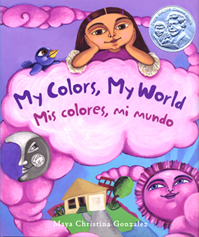
My Colors, My World/Mis colores, mi Mundo
Little Maya longs to find brilliant, beautiful, inspiring color in her world.…but Maya’s world, the Mojave Desert, seems to be filled with nothing but sand. With the help of a feathered friend, she searches everywhere to discover color in her world. In the brilliant purple of her mother\’s flowers, the cool green of a cactus, the hot pink sunset, and the shiny black of Papi\’s hair, Maya finally finds what she was looking for. The book’s appealing narrative and bold illustrations encourage early readers to observe and explore, and to discover the colors in their own
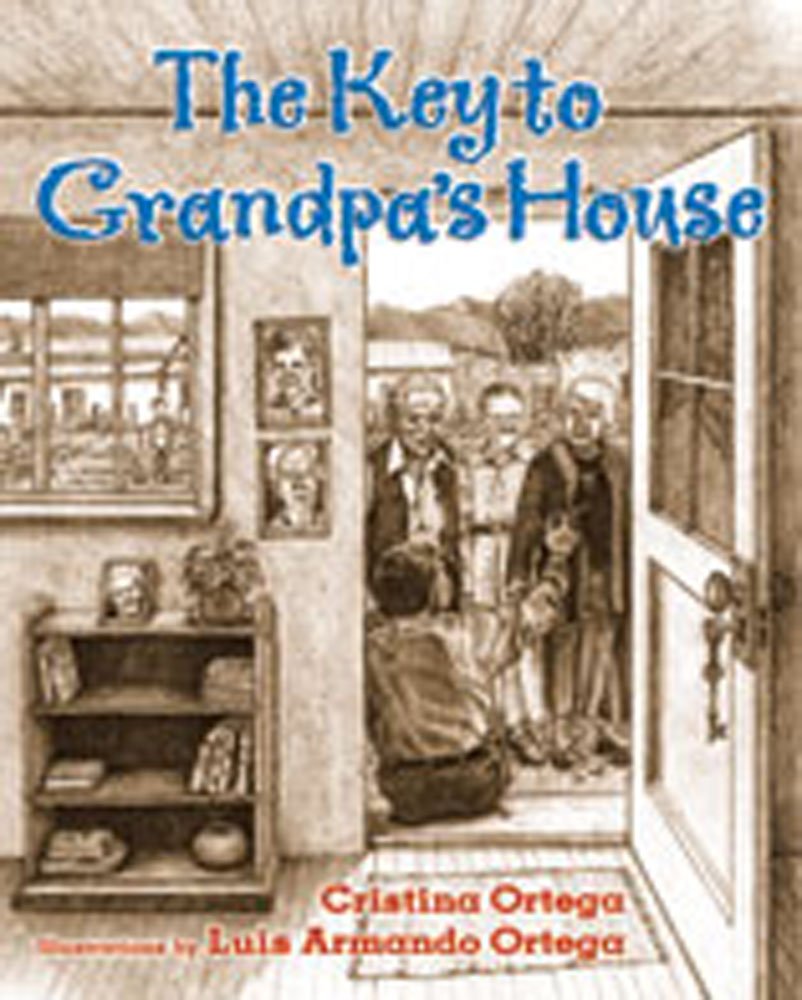
The Key To Grandpa’s House
Under a smooth gray rock on the outside windowsill of a home in Chimayo, New Mexico, sits la llave–the key–to the home of Grandpa and Grandma Ortega. The key has always been there for family, friends, and neighbors to use. When Grandma Ortega passes away, some things change and some things stay the same. Grandpa now lives alone, but his life is still filled with loving family and friends and la llave is still resting underneath its rock. Cristina Ortega’s latest children’s story represents life on a northern New Mexico plaza while highlighting the respect, friendship, trust, commitment, and love found in the community. Spanish phrases within the text and detailed illustrations by Cristina’s brother, Luis Armando Ortega, combine to demonstrate to children the importance of these timeless values.Reading level: grade 4 and up
The Moon is La Luna: Silly Rhymes in English And Spanish
This book is full of monos, ratons, and osos. What’s that, you say? You don’t know what a mono is? What about a rio, some pelo, or even an árbol? No? Still no idea? You should read this libro, then. By the time you finish, you’ll be able to recognize and understand more than fifty simple Spanish words. You’ll be saying, “Mas, por favor!” You may even ask your papá to buy you a gato or pato. (But not your papa. Potatoes can’t buy pets.)
Prietita and the Ghost Woman / Prietita Y La Llorona
In a bilingual retelling of a famous Mexican legend, Prietita sets out to find the missing herb that can cure her mother’s illness and, while lost in the woods, comes face to face with the mysterious la Llorona, the ghost woman.